
IVF Lab & Cryo Management Software: From Oocyte Collection to Cryo Storage Renewal

How an IVF lab can track every sample, embryo, tank and renewal in one system, and stay audit-ready while it grows.
Every IVF lab runs on records. An oocyte collected at OPU becomes an embryo, a grade, a straw in a tank and, months later, a renewal invoice or a transfer.
Patients hand the lab something they cannot replace. They may not see their embryos again for years, and they trust the clinic to know exactly where each one is, what condition it was frozen in, and what they agreed should happen to it. The lab’s records are how the clinic keeps that promise.
When the lab is small, paper registers and spreadsheets hold this together. As cycles grow, they start to break: samples are harder to find, renewals slip past their dates, and audit preparation takes days.
This guide walks through the lab journey stage by stage: collect, culture and grade, freeze & store, renew, and audit. For each stage, it covers what a lab needs to record, where manual systems fail, and what to look for in IVF lab management software.
Why lab and cryo records break down as a clinic grows
Lab records fail at the hand-offs, not in the middle of a procedure. A sample moves between people, rooms, days and systems, and each move is a chance to lose information.
The pressure points are predictable:
- Volume: more cycles mean more dishes, more straws and more entries on the same register.
- Time: frozen samples stay in storage for months or years, by which time the embryologist who froze them may have left.
- Hand-offs: the clinician, embryologist, nurse and billing desk each hold part of the record.
- Scattered tools: the cycle sheet, the cryo register, the renewal tracker and the equipment log often live in different places.
The result is familiar to most lab directors. Finding a specific straw takes a search through registers. Renewal dates are missed. Audit preparation means rebuilding records by hand.
IVF lab management software solves this by keeping one connected record for each sample, from collection to its final use.
Stage 1: Collect — identify every sample from the start
A sample’s record is only as reliable as its first entry. Oocytes arrive from OPU, and semen samples are collected from the partner or a donor, often on the same morning.
At this stage, the lab needs to record:
- The patient and partner the sample belongs to, linked to the active cycle
- Sample type, collection time and the staff member who received it
- Semen collection details: method, analysis results and preparation
- Oocyte count at retrieval
The biggest risk here is identification. Every time a sample moves between dishes, tubes or rooms, someone must confirm it belongs to the right patient. Manual double-witnessing depends on two busy people being available at the same moment.
Electronic witnessing makes each check a scan. A label on every dish and tube is scanned at each critical step, and the system blocks a mismatch before it happens. Every check is recorded with the time and the person who did it, which becomes the lab’s chain of custody.
What to look for: sample records tied to the patient’s cycle, not a separate register, and electronic witnessing that writes to the same record.
Stage 2: Culture and grade — a growth history for every embryo
From insemination to blastocyst, each embryo changes daily, and each day’s observation shapes the transfer and freezing decision.
A good embryology record keeps a growth history for every oocyte: one view, row by oocyte and column by day, from Day 0 to Day 7. The embryologist sees at a glance which oocytes fertilised, how each cleaved and which reached blastocyst.
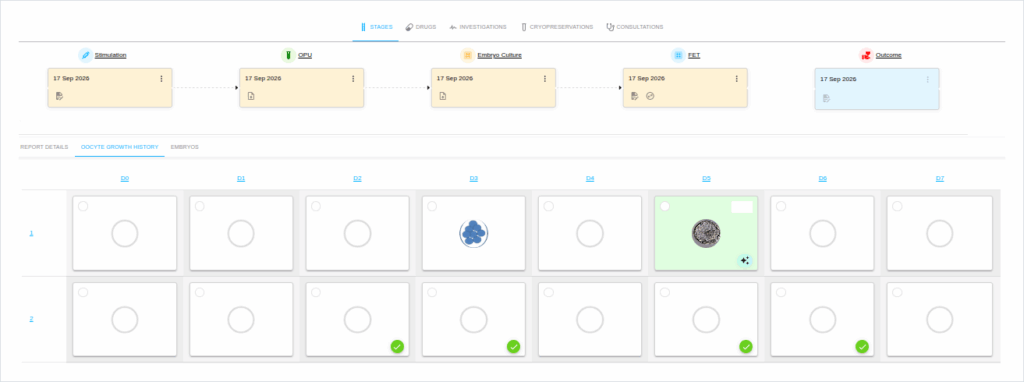
For each embryo, the lab should be able to record:
- Fertilisation check and day-by-day development stage
- Grade at each assessment, using the lab’s own grading scheme
- Images captured at each observation
- The decision: transfer, freeze or discard
When grades sit in a notebook, they are hard to compare across cycles and impossible to analyse. When they sit in a structured record, the lab can review fertilisation, cleavage and blastocyst rates month by month or quarter by quarter.
What to look for: a day-by-day growth view per oocyte, grading fields that match your lab’s scheme, and image capture on the same record.
Stage 3: Freeze and store — know exactly where every straw is
Cryo storage is where records matter longest. A straw frozen today may be thawed years later, by a different embryologist, for a patient who has moved cities.
At vitrification, the record should capture:
| What to record | Why it matters |
|---|---|
| Freezing date and method (vitrification or slow freezing) | The thaw protocol depends on it |
| Number of embryos or oocytes per straw | Shows what is available, used and remaining |
| Development stage, grade and quality at freezing | Guides which embryo to thaw first |
| PGT status | Separates tested and untested embryos |
| Device and colour coding (straw or cryo device colour, visotube colour) | Matches the record to what the embryologist sees in the tank |
| Exact location: tank, canister, cane and straw number | Finds the sample in minutes, not hours |
| Branch | Essential for multi-centre groups |
Two views make storage manageable as it grows. The first is a sample record showing total, used and available embryos for each freezing. The second is a patient view consolidating every frozen embryo across all of that patient’s cycles, so the clinician plans the next transfer from one screen.
What to look for: location down to the straw, colour-coding fields, and a consolidated view of each patient’s frozen embryos across cycles.
Stage 4: Renew — keep storage, consent and billing in step
Every frozen sample is stored for an agreed period. When that period ends, the clinic needs the patient’s decision: renew, use, donate or discard. Each option needs a valid, recorded consent.
This is where many clinics quietly lose control. Renewal dates sit in a register nobody checks daily. Patients are not reminded. Samples stay in tanks past their paid period, unbilled, with expired consent.
The fix is automation:
- Expiry calculated at freezing. The storage period chosen at freezing sets the expiry date automatically.
- Alerts before expiry. The lab and front office see upcoming and overdue renewals on a dashboard.
- Patient reminders. The patient receives an automatic reminder, ideally on WhatsApp, where they actually read messages.
- Renewal recorded on the sample. Each renewal extends the expiry date and builds a renewal history on the same record.
- Consent attached to each sample. Consent is signed digitally and attached to the individual sample record, so it can be produced in seconds before any renewal, transfer or disposal decision.
- Invoice raised on renewal. Renewing a sample creates its storage invoice automatically, so the renewal and the fee never fall out of step.
Storage fees: revenue the clinic has already earned
Storage fees are steady, recurring income, and they are usually the least tracked line in an IVF clinic’s books. When renewals live in a register, the leaks are quiet: a reminder that was never sent, a patient who never decided, a fee that was never raised.
Each of these is also an open patient decision. A sample with no renewal, no payment and no current consent is a revenue problem and a compliance problem at the same time. Linking the expiry date, the reminder, the consent and the invoice to one sample record closes both.
What to look for: auto-calculated expiry dates, automatic patient reminders, a renewal history on each sample, consent attached to each sample, and an invoice raised the moment a sample is renewed.
Fertility preservation: the same records, a longer horizon
Fertility preservation programmes, such as egg freezing, sperm banking and freezing before cancer treatment, put the heaviest demands on lab records.
Three things make them different from a standard IVF cycle:
- Storage runs for years. A patient who freezes eggs at 32 may not return until 38. The record must stay accurate and findable for the whole period.
- There is no active treatment cycle. The sample has to be tracked on its own, linked to the patient rather than to an ongoing cycle.
- Contact is infrequent. Renewal reminders and consent updates are often the only regular contact between the clinic and the patient.
Software for fertility preservation management therefore needs the full storage record from Stage 3 and the renewal automation from Stage 4, working reliably over years rather than months.
What to look for: sample records that stand on their own without an active cycle, long-term renewal tracking, and patient reminders on a channel the patient uses.
Stage 5: Audit — equipment, KPIs and an always-ready trail
A lab is audit-ready when it can show what happened to any sample, and prove its equipment was in range, without preparing for days.
Equipment compliance. Embryos are only as safe as the equipment around them. Liquid nitrogen tanks, incubators and other critical equipment need scheduled checks, and each reading must be recorded against an acceptable range.
For example, a nitrogen tank may need its level checked twice a day, with an acceptable range of 70–90%. The software should show each item’s status at a glance:
- Compliant: the reading was recorded and within range
- Non-recorded: a scheduled reading was missed
- Non-compliant: the reading fell outside the range
Some systems connect to tank sensors; others rely on readings entered by staff at set times. Either way, the test is the same: does the system flag a reading that was missed, not only one that was out of range? A missed check is the gap auditors find first.
Lab KPIs. When embryology data is recorded in structured fields, KPI reports follow automatically. Fertilisation, cleavage and blastocyst rates can be reviewed monthly or quarterly, without anyone compiling a spreadsheet.
The audit trail. Every sample movement, witness check, renewal and consent is time-stamped with the person who recorded it. In India, the ART (Regulation) Act, 2021 requires clinics to maintain records of their procedures. A connected system turns that obligation into a by-product of daily work.
What to look for: scheduled equipment readings with range checks and status flags, embryology KPI reports by date range, witness and audit logs you can export.
Checklist: questions to ask in an IVF lab software demo
Use these questions to test any lab or cryo system against your own workflow. Ask the vendor to show each one on screen, not describe it.
| Stage | Ask the vendor to show you |
|---|---|
| Collect | How a semen or oocyte sample is linked to the patient’s cycle at collection |
| Collect | How witnessing works, and where each witness check is recorded |
| Culture and grade | The Day 0–7 growth history for one cycle, with grades and images |
| Freeze and store | Where a single straw is stored, down to tank, canister, cane and straw |
| Freeze and store | All frozen embryos for one patient across every cycle |
| Renew | Upcoming and overdue renewals, and the reminder the patient receives |
| Renew | The consent attached to a specific frozen sample |
| Renew | The invoice created when a sample is renewed |
| Audit | Today’s equipment readings and any missed or out-of-range checks |
| Audit | An embryology KPI report for last quarter |
If you are choosing a full clinic system rather than a lab module alone, read our guide to choosing an IVF EMR alongside this checklist.
How ARTis manages the IVF lab, from collection to renewal
ARTis covers every stage of this journey in one system, connected to the patient’s clinical record and billing.
| Stage | What ARTis does |
|---|---|
| Collect | Records oocyte and semen collection against the patient’s active cycle. Electronic witnessing runs through Sentinel, ARTis’s own QR-based witnessing system, integrated with the same record. |
| Culture and grade | Shows a Day 0–7 growth history for every oocyte, with images, development stage and grade for each embryo. |
| Freeze and store | Records freezing date, method, development stage, grade, quality and PGT status. Stores the exact location (tank, canister, cane, straw number), cryo device colour and visotube colour, by branch. |
| Track availability | Shows total, used and available embryos for each freezing, and consolidates a patient’s frozen embryos across all cycles. |
| Renew | Calculates expiry dates automatically, alerts the clinic, and sends patients automatic WhatsApp renewal reminders. Each renewal is logged in the sample’s renewal history and raises the storage invoice automatically. |
| Consent | Captures consent digitally and attaches it to each frozen sample. |
| Audit | Schedules equipment readings, such as nitrogen tank levels, against set ranges and flags each item as compliant, non-recorded or non-compliant. Embryology KPI and witness workflow reports run for any date range. |
Because lab, clinical and billing data live in one place, a single renewal updates the sample’s expiry, raises the invoice, and is seen by the lab, the front office and billing at once.
How long does it take your team to find a specific straw today? If the answer is more than a few minutes, see how ARTis handles it in a demo.
Frequently asked questions
What is IVF lab management software?
IVF lab management software records everything that happens to gametes and embryos in the lab: collection, culture, grading, freezing, storage location, renewals and disposal. It links each sample to the patient’s cycle and keeps an audit trail of every action.
What should IVF cryo management software track?
At minimum: freezing date and method, number of embryos or oocytes per straw, development stage and grade, exact storage location down to the straw, expiry date, renewal history and the consent attached to each sample.
How does software help with cryopreservation renewals?
It calculates the expiry date when the sample is frozen, alerts the clinic before it falls due, and reminds the patient automatically. Each renewal is logged on the sample, so overdue storage is visible instead of forgotten.
How does cryo management software affect clinic revenue?
Storage fees recur for as long as samples stay frozen. When expiry dates, patient reminders and invoices are linked to each sample, renewals are raised and followed up on time, instead of being found months later during a register check.
How should consent be linked to frozen samples?
Consent should be attached to the individual sample record, not only filed in the patient’s folder. Then the lab can produce the consent for any straw in seconds and check it before every renewal, transfer or disposal decision.
Is electronic witnessing part of lab management software?
It can be. Some clinics run a separate witnessing system. In ARTis, witnessing runs through Sentinel, which records every check against the same sample record.
Do I need separate software for fertility preservation?
Not if your lab system can track frozen samples independently of a treatment cycle, over many years, with automated renewals and reminders. Fertility preservation uses the same storage records as IVF, over a longer period.
